


- Home
- Industry Articles
- How to Choose the Right LED for Your Application
How to Choose the Right LED for Your Application
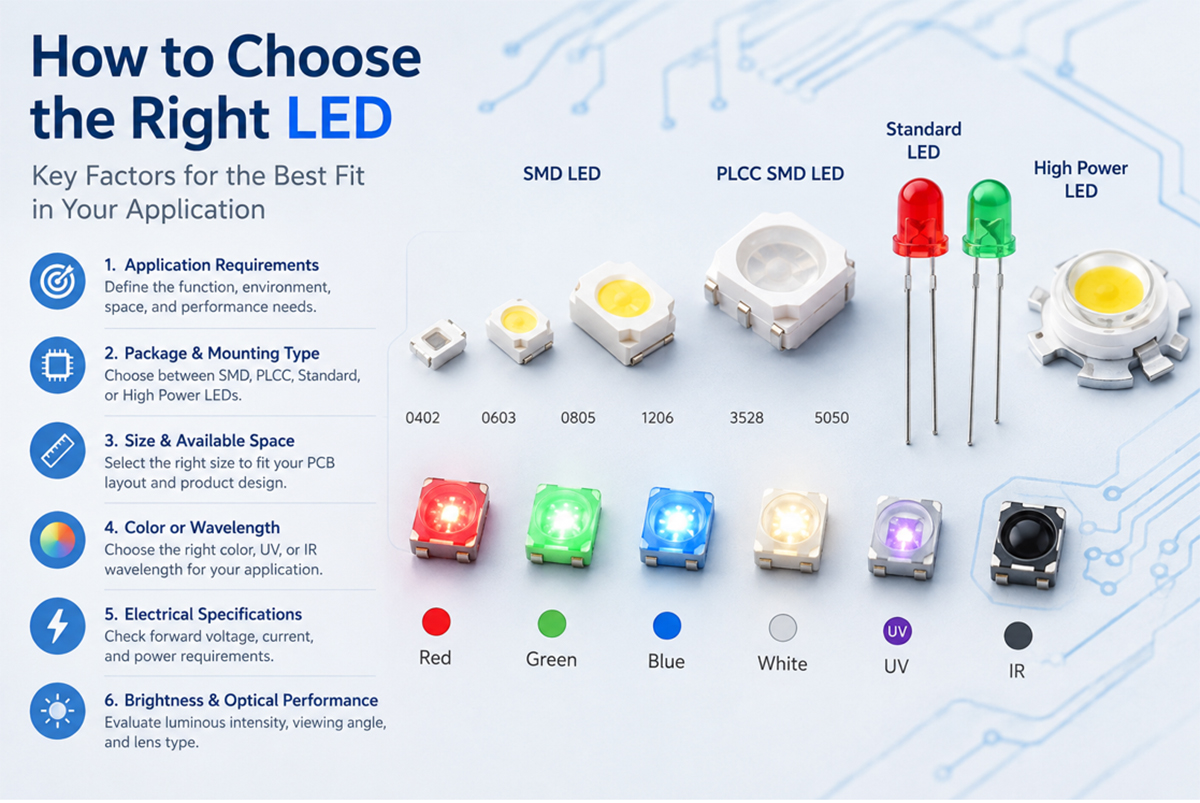
Choosing the right LED is about more than selecting a color or brightness level. The LED package, size, electrical characteristics, mounting method, optical requirements, and application environment can all affect the performance and reliability of the final product.
For engineers, product designers, and purchasing teams, selecting the right LED component early in the development process can help ensure that the component fits the PCB, meets the required optical performance, and supports the product's manufacturing requirements.
So, how do you choose the right LED for your application?
1. Start With Your Application Requirements
Before comparing individual LED models, define what the LED needs to do in the finished product. Different applications can have very different requirements.
For example, an LED used as a status indicator in consumer electronics may prioritize compact size and low power consumption, while a lighting application may require higher light output and different thermal considerations.
Start by identifying the following requirements:
- Application: Indicator, display, backlighting, lighting, signaling, or another function
- Available space: PCB area and component height
- Required light output: Brightness or luminous intensity needed for the application
- Color or wavelength: Visible light, UV, or infrared
- Operating conditions: Temperature, humidity, vibration, and other environmental factors
- Electrical requirements: Forward voltage, forward current, and power requirements
- Mounting method: Surface mount or through-hole
- Production requirements: Prototype, low-volume production, or high-volume manufacturing
Defining these requirements first makes it easier to narrow down the appropriate LED package and product type.
2. Select the Appropriate LED Package and Mounting Type
The LED package determines how the component is installed and how it fits into the overall product design.
For PCB-based products where compact dimensions and automated assembly are important, Surface Mount LEDs (SMD LEDs) are a common option. SMD LEDs are designed to mount directly onto a PCB and are available in a wide range of sizes and configurations. Grand Halo offers SMD LEDs in sizes including 0402, 0603, 0805, 1206, 3020, 3528, and 5050, along with different mounting directions such as top mount, right-angle, and reverse mount.
For designs requiring a top-emitting configuration, PLCC SMD LEDs can be another option to consider. Grand Halo's PLCC product range includes configurations such as 3528 and 5050, as well as single-color, dual-color, and tri-color products.
For applications that use traditional through-hole components, Standard LEDs are available in several sizes and shapes. Grand Halo's Standard LED range includes 3mm and 5mm round LEDs as well as straw-hat and other configurations. These products are used for applications including status indicators, signage, decorative lighting, and architectural lighting.
When an application requires a higher-output LED solution, a High Power LED may be worth considering. Grand Halo's LED component portfolio includes a dedicated High Power LED category, including a 5050-1.0T High Power LED product.
The right package should therefore be selected based on the application's available space, assembly method, optical requirements, and electrical and thermal conditions—not simply by package size.
3. Consider LED Size and Available Space
LED size becomes especially important when designing compact electronic products.
Smaller packages can help engineers save PCB space and support more compact product designs. Grand Halo's SMD LED portfolio includes very small packages such as 0402/1005, as well as larger formats such as 3020, 3528, and 5050.
When selecting an LED size, consider:
- Available PCB space
- Component height restrictions
- Required viewing area
- PCB layout and routing
- Assembly process
- Optical performance requirements
A smaller package is not automatically the best choice. The package must provide the required optical and electrical performance while fitting within the mechanical constraints of the product.
4. Choose the Right LED Color or Wavelength
The required wavelength depends on what the LED is intended to accomplish.
For visible-light applications, common choices include red, orange, amber, yellow, green, blue, and white LEDs. For specialized applications, UV and infrared LEDs may be more appropriate. Grand Halo's LED components cover visible light as well as UV and infrared ranges.
For example:
- Red, green, yellow, or other visible LEDs: Indicators, displays, signaling, and lighting
- White LEDs: Illumination and backlighting applications
- UV LEDs: Specialized UV applications
- Infrared LEDs: Optical sensing and infrared applications
The wavelength should be selected based on the optical requirements of the application rather than color alone.
5. Check Forward Voltage and Forward Current
Electrical specifications are another essential part of LED selection.
Two LEDs that look similar externally may have different electrical characteristics. Before selecting a component, check whether its forward voltage and recommended operating current are compatible with the product's circuit design and driver.
Engineers should review:
- Forward voltage (VF)
- Forward current (IF)
- Power consumption
- Driving method
- Operating temperature
- Electrical tolerances
Matching the LED to the intended circuit helps ensure stable operation and prevents the component from being operated outside its specified conditions.
6. Consider Brightness and Optical Performance
Brightness is not the only optical characteristic that matters.
Depending on the application, engineers may need to evaluate luminous intensity, viewing angle, lens design, emitting direction, and color consistency.
For example, an indicator LED may need to provide sufficient visibility from different viewing angles, while a directional lighting application may require a more focused optical output.
Therefore, instead of simply asking, "Which LED is the brightest?" it is better to ask:
What optical performance does the application actually require?
This approach helps avoid selecting an LED with unnecessary performance or choosing a component that does not meet the application's actual optical requirements.
7. Evaluate Thermal and Environmental Requirements
Thermal conditions should also be considered when selecting an LED, particularly for applications involving higher power or continuous operation.
The LED package and product design should be evaluated according to the application's operating conditions, including:
- Operating temperature
- Power requirements
- Heat dissipation
- Installation environment
- Expected operating duration
Grand Halo emphasizes semiconductor optoelectronic packaging, quality assurance, and manufacturing process control, with automated die bonding, wire bonding, molding, testing, sorting, and taping processes used in its manufacturing capabilities.
For demanding applications, LED selection should therefore be considered together with package structure, thermal management, and manufacturing consistency.
8. Consider Manufacturing and Customization Requirements
The best LED for a prototype is not necessarily the best component for mass production.
When moving from product development to production, manufacturers should consider:
- Component availability
- Consistent quality
- Production capacity
- Assembly compatibility
- Long-term supply requirements
- Customization requirements
This is particularly important when the product requires a non-standard LED size, shape, color, or configuration.
Grand Halo provides LED components in a variety of package types and also states that it can follow customer samples to develop, design, and manufacture products for mass production. Its LED components can also be customized in size and emitting color.
For companies developing specialized products, working with an LED manufacturer that can support both product development and mass production can simplify the transition from prototype to production.
9. A Practical LED Selection Checklist
Before choosing an LED component, engineers and purchasing teams can use the following checklist:
| Selection Factor | Questions to Ask |
|---|---|
| Application | What function will the LED perform? |
| Package | SMD, PLCC, Standard, or High Power LED? |
| Size | How much PCB and mechanical space is available? |
| Color / Wavelength | What wavelength or color does the application require? |
| Electrical | Are VF and IF compatible with the circuit? |
| Optical | What brightness, viewing angle, and light distribution are required? |
| Thermal | What operating temperature and power conditions must be supported? |
| Mounting | Is surface mounting or through-hole mounting required? |
| Manufacturing | Is the component suitable for the intended assembly process? |
| Supply | Can the component support long-term production requirements? |
| Customization | Is a custom size, shape, or emitting color required? |
Choosing the Right LED Is a System-Level Decision
There is no single "best" LED for every application. The right choice depends on how the LED's package, size, electrical characteristics, optical performance, mounting method, thermal requirements, and manufacturing needs work together.
For compact PCB designs, SMD LEDs can provide a practical surface-mount solution. PLCC LEDs offer additional package configurations, while Standard LEDs remain suitable for many through-hole applications. High Power LEDs can be considered when the application calls for a higher-output LED solution.
The most effective selection process begins with the end product rather than the LED catalog. By defining the application requirements first and then matching the appropriate LED package and specifications, engineers can make a more informed decision and reduce the risk of costly redesigns.
Need Help Selecting an LED Component?
Grand Halo provides a broad range of LED components, including SMD LEDs, PLCC SMD LEDs, Standard LEDs, High Power LEDs, and other optoelectronic components. With experience in semiconductor optoelectronic sealing and packaging, product development, automated manufacturing, and quality assurance, Grand Halo can support customers from component selection through product development and mass production.
If you have an existing sample or specific product requirements, contact Grand Halo to discuss the LED component that best fits your application.