


- Home
- Industry Articles
- Photodiode vs. Phototransistor: What’s the Difference and Which One Should You Use?
Photodiode vs. Phototransistor: What’s the Difference and Which One Should You Use?
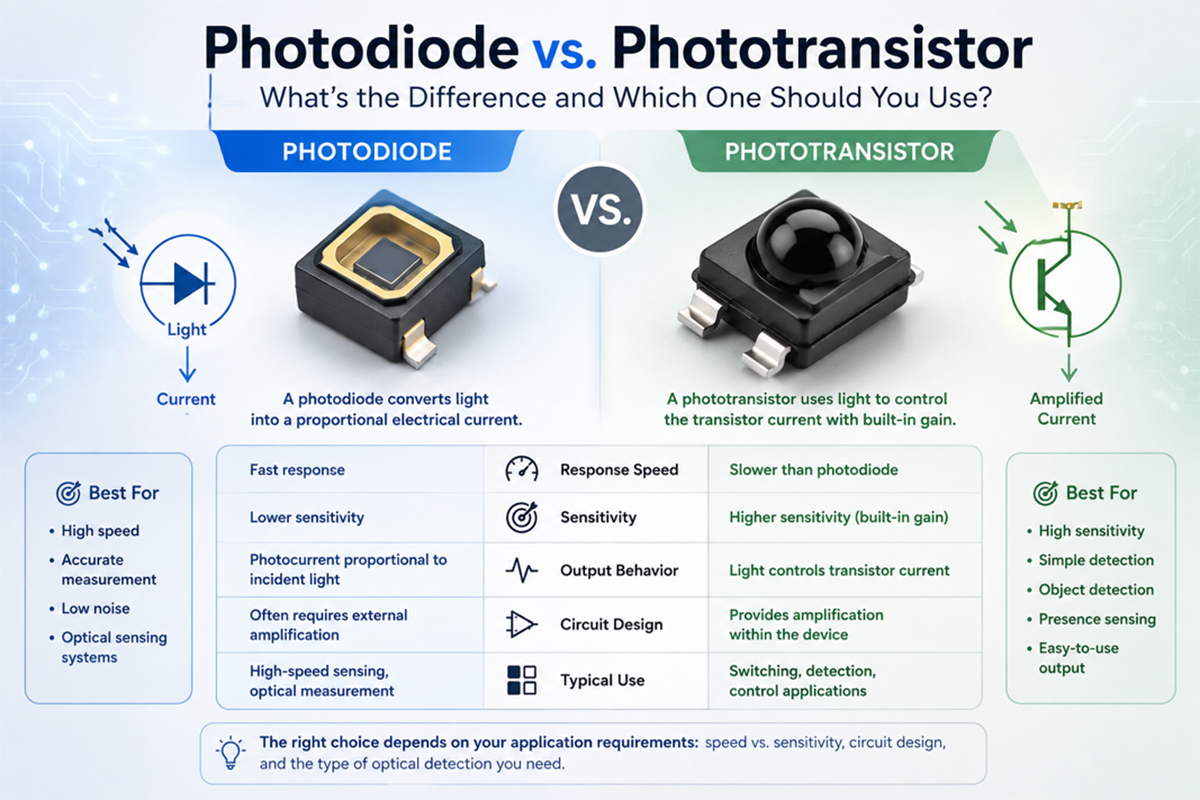
Photodiodes and phototransistors are both widely used for detecting light and converting optical signals into electrical signals. Although they can serve similar functions, their operating characteristics and performance make them suitable for different applications.
Choosing between a photodiode and a phototransistor depends on factors such as response speed, sensitivity, circuit requirements, signal characteristics, and the intended application.
So, what is the difference between a photodiode and a phototransistor, and which one should you use?
What Is a Photodiode?
A photodiode is a semiconductor device that detects light and generates an electrical response based on the amount of incident light. Photodiodes are commonly used in optical sensing and detection systems where accurate and responsive light detection is required.
Photodiodes can be used in applications such as:
- Smoke detectors
- Optical sensing systems
- Remote controls
- Camera-related devices
- Consumer electronics
- Light detection systems
Grand Halo's photodiode portfolio includes several package configurations, including 1208/3020 Right Angle PD, 0603/1608-0.6T PD, 1311/3227-1.1T PD, 1306/3216-1.1T PD, 1309/3224 Lens PD, and 4412 PD.
Key Characteristics of Photodiodes
Photodiodes are often considered when an application requires:
- Fast response to changes in light
- Accurate light detection
- Compact optical sensing components
- Low-light detection
- Integration into sensor systems
The appropriate photodiode should ultimately be selected based on the required spectral response, sensitivity, speed, package, and circuit design.
What Is a Phototransistor?
A phototransistor is a light-sensitive transistor that uses incident light to control its electrical output. Because the transistor structure provides signal amplification, phototransistors can offer higher sensitivity than a basic photodiode in many detection applications.
Phototransistors are commonly used in applications where light detection needs to produce a readily usable electrical signal.
Grand Halo's phototransistor products are designed for light detection and are used in applications including security systems, punch card readers, IR detectors, electronic controls, relays, light controls, counting systems, and level indicators.
Key Characteristics of Phototransistors
Phototransistors can be a good choice when an application requires:
- High sensitivity to light
- Simple light detection
- A stronger electrical response
- Reliable object or signal detection
- Compact integration into electronic products
Like photodiodes, phototransistors are available in different package configurations to meet different mechanical and optical requirements.
Photodiode vs. Phototransistor: Key Differences
Although both components detect light, their operating characteristics can lead to different design choices.
| Feature | Photodiode | Phototransistor |
|---|---|---|
| Primary function | Light detection | Light detection with transistor amplification |
| Sensitivity | Suitable for precise light detection | Generally higher sensitivity |
| Response speed | Typically faster | Typically slower than a photodiode |
| Output behavior | Photocurrent proportional to incident light | Light controls transistor current |
| Circuit design | Often requires additional signal amplification | Can provide amplification within the device |
| Typical use | High-speed sensing and optical measurement | Switching, detection, and control |
| Best suited for | Applications prioritizing speed and signal accuracy | Applications prioritizing sensitivity and straightforward detection |
The exact performance depends on the specific device design and specifications, so engineers should always compare the manufacturer's datasheet values before making a final selection.
Photodiode vs. Phototransistor: Which Is More Sensitive?
Sensitivity is one of the most important considerations when comparing these two components.
A phototransistor incorporates transistor gain, allowing a relatively small amount of incident light to produce a larger electrical response. This makes phototransistors useful for applications where detecting the presence or absence of light is more important than measuring light with high precision.
A photodiode, by comparison, generates a photocurrent directly from incident light and can be paired with external circuitry for signal amplification and processing.
Therefore, if the primary requirement is high sensitivity for straightforward light detection, a phototransistor may be a suitable choice.
If the application requires more precise optical measurement, fast response, or greater flexibility in signal processing, a photodiode may be preferable.
Photodiode vs. Phototransistor: Which Is Faster?
Response speed can be another important factor.
Photodiodes are generally preferred for applications requiring fast optical response. Their direct conversion of incident light into photocurrent makes them suitable for systems where rapid changes in optical signals need to be detected.
Phototransistors can provide greater sensitivity through transistor gain, but this can come with a trade-off in response speed.
For applications involving fast signal detection, engineers should therefore examine the photodiode and phototransistor datasheets carefully and compare parameters such as response time, rise time, and fall time.
When Should You Choose a Photodiode for Speed?
A photodiode may be the better option when:
- The application requires rapid light detection
- Optical signals change quickly
- Precise signal measurement is important
- The circuit can accommodate external amplification or signal conditioning
When Should You Choose a Phototransistor for Sensitivity?
A phototransistor may be a better fit when:
- Detecting the presence or absence of light is the primary goal
- Higher sensitivity is important
- A stronger electrical response is desirable
- The application does not require extremely fast response
Photodiode vs. Phototransistor Applications
The right choice also depends on the type of product being developed.
Applications for Photodiodes
Photodiodes are commonly considered for applications involving optical sensing, measurement, and light detection.
Examples include:
- Smoke detectors
- Optical sensors
- Camera-related equipment
- Remote controls
- Consumer electronics
- Light detection systems
Grand Halo's photodiode products are designed for applications including smoke detectors, compact disc players, televisions, camera lights, clock radios, street lights, and remote controls.
Applications for Phototransistors
Phototransistors are often used when the system needs to detect an optical signal and convert it into a usable electrical response.
Typical applications include:
- Security systems
- IR detectors
- Electronic controls
- Relays
- Light controls
- Counting systems
- Level indicators
Grand Halo specifically lists these applications for its phototransistor products.
What About Infrared LEDs?
Photodiodes and phototransistors are light receivers. An infrared emitting diode (IR LED) serves the opposite role: it emits infrared light.
An IR LED can be used together with a photodiode or phototransistor to create an optical sensing system. The IR LED sends infrared light, while the receiver detects the transmitted or reflected light.
Grand Halo's IR LED portfolio includes wavelengths such as 770 nm, 870 nm, 880 nm, 940 nm, and 950 nm, with different package configurations and power output options. Its listed applications include smoke detectors, encoders, transmissive opto switches, cameras, remote controls, security cameras, CCTV systems, and burglar alarm systems.
IR LED + Photodiode vs. IR LED + Phototransistor
The choice of receiver can affect the performance and design of an infrared sensing system.
For example:
IR LED + Photodiode
An IR LED can be paired with a photodiode when the system requires fast or more precise optical detection and the circuit can provide the required signal conditioning.
IR LED + Phototransistor
An IR LED can be paired with a phototransistor when the application prioritizes sensitivity and straightforward detection of an infrared signal.
The correct combination depends on the required sensing distance, response speed, optical environment, signal processing, and circuit design.
How to Choose Between a Photodiode and Phototransistor
Before selecting a component, consider these key questions:
1. Do You Need High-Speed Detection?
If the application involves rapidly changing optical signals, a photodiode may be the better starting point.
2. Is High Sensitivity More Important?
If the main requirement is detecting relatively weak light signals without complex external amplification, a phototransistor may be worth considering.
3. Do You Need Precise Optical Measurement?
Photodiodes can be a better fit for applications where the electrical output needs to closely track changes in incident light and where external signal processing is acceptable.
4. Is the Component Used for Simple Detection or Switching?
For applications that mainly need to determine whether light is present or absent, a phototransistor can provide a practical solution.
5. What Package Does Your Product Require?
Package size, mounting direction, lens configuration, and PCB layout can all affect the appropriate component.
Grand Halo offers multiple photodiode and phototransistor package configurations, including small SMD packages and right-angle or lens-based configurations.
Photodiode vs. Phototransistor Selection Checklist
Use this checklist when evaluating an optical receiver for a new product:
| Selection Factor | Photodiode | Phototransistor |
|---|---|---|
| High-speed response | ✓ Strong candidate | △ Depends on device |
| High sensitivity | △ Depends on circuit | ✓ Strong candidate |
| Precise optical measurement | ✓ Strong candidate | △ Application dependent |
| Simple light detection | ✓ Suitable | ✓ Strong candidate |
| External signal conditioning | Often useful | May be less demanding |
| Compact package options | Available | Available |
| Infrared sensing | ✓ Suitable | ✓ Suitable |
| Switching / object detection | Suitable | ✓ Common choice |
These comparisons are general design guidelines rather than universal rules. Actual performance varies by component, package, wavelength, circuit, and operating conditions. Always refer to the manufacturer's specifications when selecting a production component.
Which One Should You Use?
There is no universal winner between a photodiode and a phototransistor.
Choose a photodiode when your design prioritizes fast response, precise optical detection, or flexibility in external signal processing.
Choose a phototransistor when your design prioritizes sensitivity and straightforward light detection, particularly for applications such as switching, counting, control, and object detection.
If your application uses infrared light, an IR LED can be combined with either type of receiver depending on the required optical and electrical characteristics.
The most important step is to start with the requirements of the finished product and then evaluate the receiver's sensitivity, response speed, spectral characteristics, package, operating conditions, and circuit compatibility.
Find the Right Optoelectronic Component for Your Application
Grand Halo provides photodiodes, phototransistors, and infrared emitting diodes in multiple package configurations for different sensing and detection applications. The company's product portfolio includes compact SMD configurations as well as right-angle and lens-based options.
If you are developing a new optical sensing product or need help selecting the appropriate PD, PT, or IR component, contact Grand Halo to discuss your application requirements.